









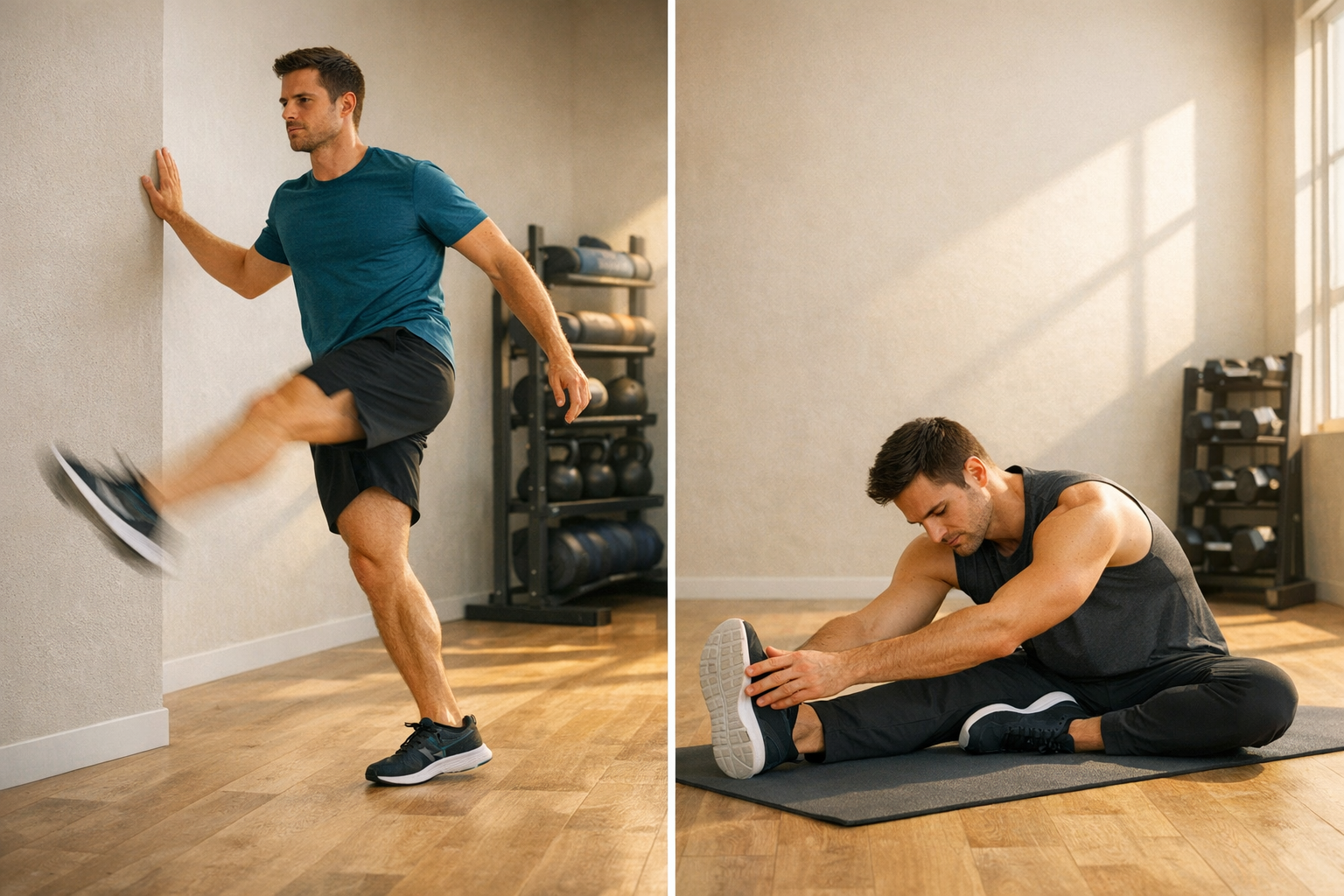
Dynamic Stretching vs. Static Stretching for Injury Prevention
Dynamic stretching and static stretching serve different purposes in your fitness routine, each playing a role in preventing injuries and improving performance. Here's the key takeaway:
- Dynamic stretching involves active, controlled movements that warm up muscles, increase blood flow, and mimic workout motions. It's best used before exercise to prepare your body for physical activity and improve performance.
- Static stretching involves holding a stretch in one position to lengthen muscles and reduce tension. It's ideal for post-workout cooldowns or rest days to improve flexibility and aid recovery.
Quick Facts:
- Dynamic stretching boosts performance (e.g., a 2% increase in vertical jump height) and reduces injury risk by up to 30%.
- Static stretching helps prevent muscle strains and stiffness but can reduce strength if done before exercise.
- Use dynamic stretches like leg swings or walking lunges pre-workout and static stretches like hamstring or quad stretches post-workout.
Quick Comparison:
| Factor | Dynamic Stretching | Static Stretching |
|---|---|---|
| Purpose | Prepares muscles for activity | Aids recovery and improves flexibility |
| When to Use | Before workouts | After workouts or on rest days |
| Key Benefit | Boosts blood flow and performance | Reduces stiffness and tension |
| Examples | Leg swings, walking lunges | Hamstring stretch, quad stretch |
| Performance Impact | Improves power and coordination | May reduce strength if done pre-workout |
Pair both techniques for the best results: dynamic stretching before exercise and static stretching afterward. This approach not only enhances performance but also lowers your risk of injury.
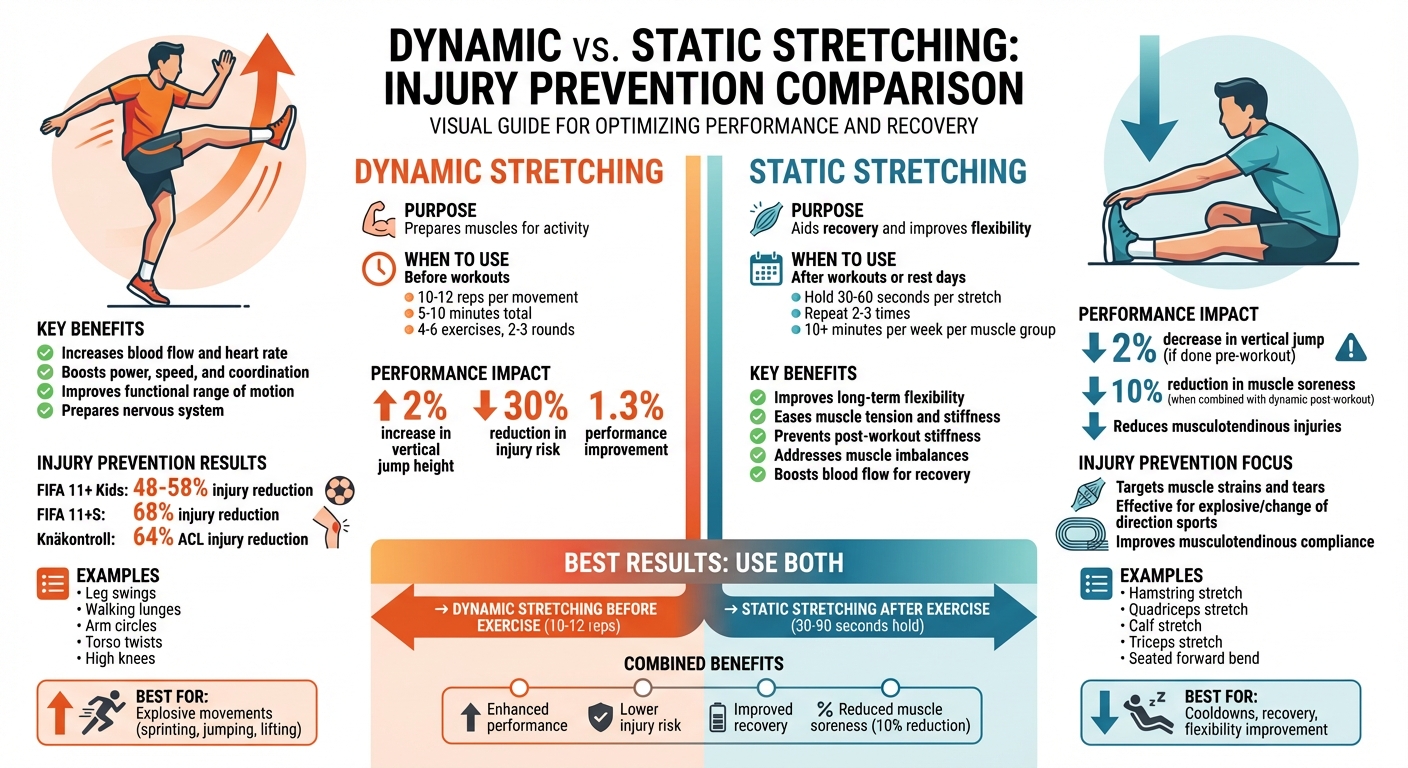
Dynamic vs Static Stretching: When to Use Each for Injury Prevention
What Is Dynamic Stretching?
Dynamic stretching is all about movement. It involves actively moving your joints and muscles through their full range of motion using smooth, repetitive motions. Unlike static stretching, where you hold a single position, dynamic stretching keeps you moving - often mimicking the actions you'll perform during your workout or sport.
The goal? To get your body ready for action. Dr. Anne Rex, DO, from Cleveland Clinic, explains:
"Dynamic stretching mimics the activity or the movement that you're going to do in whatever sport or activity you're about to start. It helps rehearse the movement patterns so the muscles tend to get excited a little bit earlier and faster, which can help improve power and increase coordination."
Dynamic stretching does more than just warm you up. It gradually increases your heart rate, boosts blood flow, and loosens up your muscles. Research even shows it can improve vertical jump height by an average of 2% and lower the risk of injuries by as much as 30%.
Key Characteristics of Dynamic Stretching
This type of stretching is all about active muscle engagement. Instead of passively holding a position, you're in control, moving with purpose. The intensity and range of motion build gradually, like a dress rehearsal for your workout. It’s a great way to wake up your nervous system and muscles, so they’re fully prepared for the real deal.
A typical dynamic warm-up might include 10 to 12 repetitions of each movement, targeting the muscle groups you'll use during your workout. These routines usually feature four to six exercises, repeated for two to three rounds, and take about 5 to 10 minutes to complete.
Examples of Dynamic Stretches
Some go-to dynamic stretches include leg swings, where you balance on one leg and swing the other forward and backward or side-to-side. This stretch helps loosen up your hamstrings and hip flexors. Walking lunges are another popular choice - they not only stretch but also activate your glutes, hamstrings, quads, and core.
Other examples include arm circles to improve shoulder mobility, torso twists to keep your spine flexible, and the World's Greatest Stretch, which targets multiple areas like your core, hamstrings, calves, glutes, quads, back, chest, and shoulders. If you're prepping for weightlifting, the cat-cow pose is a great way to move your spine through flexion and extension, helping to avoid back strain.
Next, we’ll dive into static stretching and how it plays a different role in your fitness routine.
What Is Static Stretching?
Static stretching is all about holding a position to gently lengthen your muscles and surrounding tissues. It involves moving a muscle or joint to the point where you feel a mild stretch - then staying in that position for 20–90 seconds. This type of stretching is passive, meaning you’re focusing on relaxing rather than actively warming up. You might be standing, sitting, or lying down as your muscles slowly loosen and release tension. Over time, this practice can help improve flexibility, increase your range of motion, and support recovery after workouts.
Dr. Anne Rex from Cleveland Clinic puts it simply:
"Static stretching works well as part of the cooldown process... it's really more of a relaxation movement."
Static stretching is most beneficial after exercise. It helps muscles return to their normal length, reduces stiffness, and even calms your nervous system. Research suggests that pairing static and dynamic stretching after resistance training can cut muscle soreness by around 10% compared to skipping stretches altogether.
Key Characteristics of Static Stretching
What sets static stretching apart is the stillness - it’s all about holding a position without bouncing or pulsing. The goal is to relax the muscle completely. Your body uses a mechanism called autogenic inhibition, where the nervous system detects tension and encourages the muscle to relax and lengthen. To get the most out of it, hold each stretch for 30–60 seconds and repeat 2–3 times. Always stop when you feel a gentle pull; stretching should never be painful.
Examples of Static Stretches
Here are some popular static stretches you can try:
- Hamstring stretch: Sit on the floor with one leg extended and lean forward from your hips to reach your toes.
- Quadriceps stretch: Stand on one leg and pull the opposite ankle toward your buttocks.
- Calf stretch: Face a wall, step one foot back, and press your heel into the ground.
- Triceps stretch: Reach one arm overhead, bend your elbow to touch your back, and gently push the elbow down with your other hand.
- Seated forward bend: Sit with both legs extended and lean forward from the hips.
- Posterior capsule stretch: Bring one arm across your chest and gently pull it toward your body to stretch your shoulder.
Next, let’s look at how static stretching can play a role in preventing workout injuries.
How Dynamic Stretching Prevents Injuries
Dynamic stretching helps prevent injuries by preparing your body for movement. It activates the nervous system, increases blood flow, raises muscle temperature, and improves joint mobility. By performing movements that mimic your workout, you’re essentially giving your muscles a preview of what’s coming. This "rehearsal" sharpens communication between your brain and muscles, ensuring they respond faster and more effectively when needed.
The repetitive motion involved in dynamic stretching increases blood flow and warms up the muscles, making them more flexible and less prone to tears. It also takes advantage of the thixotropic effect - a fancy way of saying that movement reduces the stiffness of muscle and fascia fluids. This allows tissues to move more smoothly, helping your muscles and tendons handle stress better, especially during extended stretches, which lowers the risk of strain.
Research strongly supports these benefits. For example, warm-up routines that include dynamic stretching, like the FIFA 11+ Kids, have been shown to reduce injury rates by an impressive 48% to 58% among young athletes. The FIFA 11+S program for male goalkeepers achieved an even greater 68% reduction in injuries. Similarly, the Knäkontroll program, designed for adolescent female soccer players, reduced ACL injuries by 64%. Beyond injury prevention, dynamic stretching can even improve performance - boosting vertical jump height by about 2%, whereas static stretching can lower it by the same amount.
To maximize the benefits, focus on sport-specific, controlled movements and keep your dynamic stretching routine under 12 minutes. Overdoing it could lead to fatigue, which might hurt performance.
Pros and Cons of Dynamic Stretching
| Pros | Cons |
|---|---|
| Increases blood flow and heart rate, getting muscles ready for action | Challenging for beginners to perform correctly compared to static stretches |
| Boosts power, speed, and coordination, enhancing overall performance | Excessive volume may cause fatigue or slight performance dips |
| Improves functional range of motion and joint flexibility | Not ideal for those with severe mobility issues or acute injuries |
| Prepares the nervous system for specific movements in your sport | Minor strain risk if loads aren’t well-controlled, especially for older adults |
sbb-itb-7567710
How Static Stretching Prevents Injuries
Dynamic stretching gets your body ready to move, but static stretching steps in after activity to boost muscle resilience. By improving how muscles and tendons handle force, static stretching helps them absorb the stress of sudden, intense movements like sprinting or jumping. This ability to improve musculotendinous compliance plays a key role in reducing the risk of strains and tears.
A major factor in how static stretching works is autogenic inhibition. This is a process where holding a stretch sends signals to relax the muscle being stretched. This relaxation reduces unnecessary tension and can help fix muscle imbalances that might otherwise mess with your movement patterns and increase the chance of injury. Kathy Zetterberg from NASM highlights its importance:
"Static stretching can be beneficial in many ways, such as correcting muscle imbalances, decreasing muscle hypertonicity, increasing joint ROM, relieving joint stress, improving the extensibility of the musculotendinous junction, [and] maintaining the normal functional length of a muscle".
Static stretching also prevents muscles from staying in a tight, contracted state, which could lead to strain during further activity. Plus, it boosts blood flow, delivering oxygen and nutrients that help repair tiny muscle tears caused by exercise. Studies even show that combining static and dynamic stretching after resistance training can cut muscle soreness by as much as 10% compared to skipping stretching entirely.
For the best results in long-term injury prevention, consistency is key. Aim to spend at least 10 minutes per week per muscle group on static stretching to improve flexibility. During cooldowns, hold each stretch for 30–60 seconds, focusing on large muscle groups like hamstrings, quadriceps, calves, chest, back, and shoulders. Stretch only to the point of mild tension - never to the point of pain.
This method complements dynamic warm-ups by targeting recovery and long-term flexibility. Here's a look at the upsides and downsides of static stretching:
Pros and Cons of Static Stretching
| Pros | Cons |
|---|---|
| Improves long-term flexibility and joint range of motion | Reduces power and strength if done before exercise (e.g., up to a 2% drop in vertical jump) |
| Eases muscle tension and stiffness, aiding relaxation and stress relief | Can dampen nervous system activation, slowing muscle response for up to two hours |
| Prevents post-workout stiffness by restoring muscles to their pre-exercise length | Doesn't warm up muscles or raise heart rate before activity |
| Addresses muscle imbalances and keeps muscles at functional lengths | Overstretching risks joint instability if taken too far |
| Boosts blood flow, promoting muscle recovery with oxygen and nutrients | Not ideal for acute injuries or stretching "cold" muscles without prep movement |
Next, we’ll dive into how research compares dynamic and static stretching.
Comparing the Two: What the Research Shows
Research highlights that dynamic and static stretching serve different purposes when it comes to injury prevention. Static stretching is particularly useful for reducing musculotendinous injuries, such as muscle strains and tears, especially in sports that involve explosive actions or quick directional changes. On the other hand, dynamic stretching alone has limited effectiveness but becomes highly impactful when combined with a full warm-up routine that includes strength exercises, balance work, and plyometric drills.
For example, a study involving 465 high school soccer players found no significant difference in injury rates between those who performed only dynamic stretching and those who mixed dynamic and static stretches. However, structured programs like HarmoKnee and Knäkontroll demonstrated impressive results, reducing knee injuries by 77% and ACL injuries by 64%, respectively, in adolescent female soccer players.
Performance is another critical factor. Dynamic stretching can boost performance by about 1.3%, while static stretching held for longer than 60–90 seconds might reduce strength and power output.
"While SS was unlikely to decrease all-cause injury incidence, there was evidence for a reduction in musculotendinous injuries, especially with explosive and change of direction movements."
- Sports Medicine Narrative Review
Research Findings: Dynamic vs. Static Stretching
Here’s a breakdown of the main findings that showcase the unique benefits of static and dynamic stretching:
| Factor | Static Stretching | Dynamic Stretching |
|---|---|---|
| Injury Prevention Focus | Targets musculotendinous injuries (e.g., strains, tears) | Supports joint stability and reduces lower-limb injuries when part of a broader program |
| Performance Impact | May impair performance if held >60–90 seconds | Slight performance improvement (~1.3%) |
| Range of Motion | Enhances both immediate and long-term flexibility | Improves immediate ROM; long-term flexibility effects are unclear |
| Mechanism | Reduces muscle-tendon stiffness | Boosts neuromuscular activation and raises muscle temperature |
| Best For | Activities requiring static flexibility (e.g., gymnastics) | Sports involving explosive movements (e.g., soccer, basketball, sprinting) |
This comparison helps clarify how and when to use each type of stretching to achieve the best results.
When to Use Each Type of Stretching
Dynamic stretching is ideal for your warm-up routine. This type of stretching is particularly effective before workouts involving explosive movements like sprinting, jumping, or heavy lifting. Why? It gradually increases your heart rate, improves blood flow, and warms up your muscles, making them more elastic and less resistant to movement. Aim for 10–15 reps of dynamic exercises such as leg swings, arm circles, high knees, or walking lunges. Choose movements that mimic the exercises in your workout - for example, lunges before a leg-focused session help prepare your muscles for similar patterns. After your workout, switch to static stretches during your cooldown to aid recovery.
Static stretching, on the other hand, is most effective during your cool-down or on rest days. Hold each stretch for 30–60 seconds to help lengthen muscles, ease stiffness, and relax your nervous system. Target key muscle groups like the hamstrings, quads, calves, chest, and back. For larger muscles, such as those in your legs, holding the stretch for at least 60 seconds can provide added benefits. On rest days, consider doing standalone static stretching sessions 2–3 times a week to improve flexibility. Make sure to breathe steadily during each stretch - holding your breath can cause your muscles to tense up instead of relaxing.
It’s important to avoid static stretching before activities requiring explosive power. Studies show that holding static stretches for more than 60 seconds can reduce vertical jump height by 2% and negatively affect strength and power performance. Instead, save static stretches for when your muscles are already warm or after your workout. Using the right type of stretching at the appropriate time can improve performance and reduce the risk of injury.
Final Recommendation: Combine Both for Best Results
Pairing dynamic stretching before your workout with static stretching afterward is a winning formula. Dynamic stretches prepare your muscles by boosting blood flow and raising muscle temperature, while static stretches help with recovery by restoring muscle length and reducing stiffness. For the best outcome, aim for 10–12 reps of dynamic exercises like leg swings or walking lunges before exercising, and hold static stretches for 30–90 seconds during your cool-down.
This method isn't just practical - it delivers results. Studies show dynamic stretching can improve vertical jump height by around 2%. Meanwhile, combining both stretching techniques post-resistance training can cut muscle soreness by up to 10% compared to skipping stretches altogether. Physical therapist Joe Tribotte highlights the importance of timing:
"During static stretches, athletes are going to ask those muscle fibers to relax and lengthen, and they are going to get more benefit after an athletic event".
To take your routine even further, focus on nutrition. NutriFitt’s pre-workout supplements can give you an energy boost during your dynamic warm-up, helping you get your body ready faster. After exercising, protein powders like EPIC Whey aid muscle recovery while you’re doing your static stretches.
FAQs
How long should my warm-up be?
Your warm-up should take about 5 to 10 minutes. This time frame allows your body to gradually increase its heart rate, loosen tight muscles, and get ready for physical activity. Incorporating dynamic stretches during this period is key. Spend another 5 to 10 minutes on these stretches to activate your muscles and joints without overexerting them. This combination not only boosts performance but also lowers the chance of injuries.
Can I do static stretching before lifting?
Before hitting the weights, skip the static stretching. Holding stretches for more than 60 seconds before lifting can actually hinder your performance and isn’t the best way to prepare your body. Instead, go for dynamic stretching. This approach actively warms up your muscles, boosts flexibility, and helps lower the risk of injuries.
Save static stretching for later - after your workout or during dedicated flexibility sessions. When your muscles are already warm, static stretching can help improve joint mobility and support recovery.
What if I’m tight or sore every day?
If you’re dealing with tightness or soreness on a daily basis, incorporating static stretching into your routine can make a difference. By holding stretches for less than 60 seconds, you may gradually ease discomfort and improve your flexibility and joint mobility.
Before any physical activity, adding dynamic stretches can help prepare your body, while recovery techniques like foam rolling can aid in reducing tension afterward. If the soreness doesn’t go away, it’s a good idea to consult a healthcare professional for guidance. Additionally, supplements from NutriFitt might offer extra support for recovery and overall well-being.
Latest Posts

How Ashwagandha Supports Testosterone Levels

10 Best Natural Pre-Workout Ingredients

Best Electrolyte Supplements for Fitness Goals

Best Nootropics for Productivity in 2026

Top 5 Sleep Hygiene Practices for Athletes

5 Best Pre-Workouts for Pump

The 30-Minute Body That Beats the 2-Hour One
Short, high-intensity 30-minute workouts can deliver equal or better cardio, strength, and fat-loss results than long sessions.

Checklist for Choosing Clean Label Certified Supplements
Checklist to verify certifications, ingredient transparency, batch COAs, GMP compliance, and bioavailable forms in clean-label supplements.