






Top 5 Sleep Hygiene Practices for Athletes
When it comes to athletic performance, sleep is just as important as training and nutrition. Quality sleep helps repair muscles, improve accuracy, and boost reaction times. Yet, many athletes struggle with poor sleep due to irregular schedules, adrenaline spikes, and travel disruptions. Here are five proven strategies to improve your sleep and recovery:
- Stick to a consistent sleep schedule: Go to bed and wake up at the same time daily to align your body’s internal clock.
- Optimize your sleep environment: Keep your room cool (60–70°F), dark, and quiet to promote deeper rest.
- Develop a bedtime routine: Engage in calming activities like reading or stretching to signal your body it’s time to wind down.
- Limit caffeine and alcohol: Avoid caffeine 8 hours before bed and alcohol 3–4 hours prior to sleep to prevent disruptions.
- Reduce screen time before bed: Turn off screens 1–2 hours before bedtime or use blue-light-blocking glasses to support melatonin production.
These simple changes can lead to better recovery, fewer injuries, and improved performance. Start with one or two habits and build from there for long-term results.
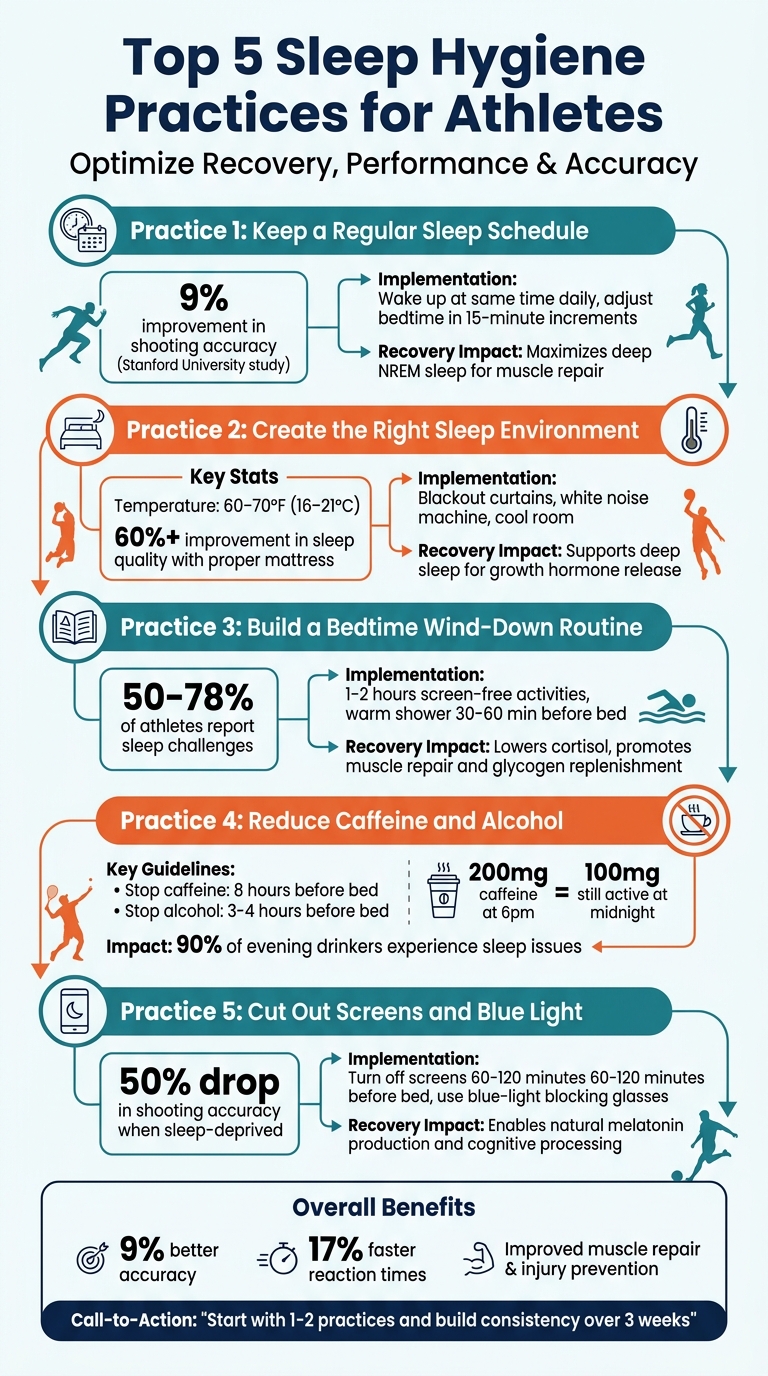
5 Sleep Hygiene Practices for Athletes: Key Benefits and Implementation Guide
1. Keep a Regular Sleep Schedule
Impact on Sleep Quality and Duration
Your body operates on a natural 24-hour cycle called the circadian rhythm, which dictates when you feel awake and when you feel ready for sleep. By sticking to the same bedtime and wake-up time daily, you're essentially fine-tuning this internal clock. This steady routine helps regulate key hormones like cortisol - which wakes you up in the morning - and melatonin, which makes you sleepy at night. The result? Falling asleep becomes easier, and your sleep quality improves.
Science supports this. A 2011 Stanford University study led by Cheri D. Mah had men's basketball players increase their nightly sleep to 10 hours over several weeks. The results were impressive: free throw and three-point shooting accuracy improved by 9%, and sprint times got faster.
"Consistency regulates the body's internal clock, optimizing sleep cycles. Athletes find that a regular sleep schedule enhances overall well-being, performance, and recovery." - Sarah Anderson, Certified Sleep Science Coach
These findings highlight how even small adjustments to your sleep habits can yield big rewards.
Ease of Implementation for Athletes
The good news? Adopting a consistent sleep schedule is simple and doesn’t cost a thing. The most important step is to wake up at the same time every day, including weekends. This consistency anchors your circadian rhythm more effectively than focusing only on your bedtime.
To ease into a new routine, move your bedtime earlier in 15-minute increments until you hit your desired schedule. Try to keep your sleep and wake times within a one-hour range daily, even on rest days. If you have early morning practices, prioritize going to bed earlier instead of cutting sleep short. For athletes traveling across time zones, start adjusting your sleep schedule by 30–60 minutes per day several days before your trip.
Effectiveness in Enhancing Recovery
A regular sleep schedule doesn’t just boost performance - it’s also critical for recovery. During deep sleep, your body focuses on repairing muscle tissue, releasing human growth hormone, and restoring energy reserves. This stage, known as deep NREM sleep, occurs mostly in the early part of the night. By sticking to a consistent bedtime, you maximize these restorative hours.
On the flip side, irregular sleep patterns disrupt melatonin production, making it harder to fall asleep and reducing the overall quality of your rest. Even if you have one bad night of sleep before a big event, you can prepare by building a "sleep reservoir." Getting solid, consistent sleep in the 5–7 nights leading up to the competition can help offset the effects of a single rough night.
sbb-itb-7567710
2. Create the Right Sleep Environment
Impact on Sleep Quality and Duration
Your sleep environment plays a huge role in how quickly you fall asleep and how well you stay asleep. A room that's cool - ideally between 60–70°F (16–21°C) - and completely dark can make a big difference. Darkness encourages the release of melatonin, the hormone that helps you feel sleepy. Even a small amount of light can disrupt this process by signaling the brain's suprachiasmatic nucleus (SCN) to suppress melatonin production. Making these changes to your sleep setup is straightforward and can significantly improve your rest.
Ease of Implementation for Athletes
The good news? Most adjustments to your sleep environment are easy and inexpensive. Start by setting your thermostat to around 65°F (18°C), using blackout curtains or a quality eye mask, and adding a white noise machine or earplugs to block out noise.
For athletes, especially those who travel frequently for competitions, bringing personal sleep items like a favorite pillow or noise-canceling headphones can help recreate a familiar and restful environment, no matter where they are.
"The hotel room should be a place that is sacrosanct for the athletes to be in a relaxed state." – Remi Mobed, Sleep Expert
These adjustments don’t just make falling asleep easier - they also ensure your body gets the recovery it needs.
Effectiveness in Enhancing Recovery
Creating the ideal sleep environment supports deep sleep (NREM stage 3), which is when your body does the heavy lifting of recovery. During this phase, growth hormone is released, muscle fibers are repaired, and glycogen stores are replenished. Without the right setup, you might spend more time in lighter sleep stages, which don’t offer the same benefits. Studies show that a high-quality mattress can improve sleep quality by over 60% and significantly reduce muscle pain. Experts recommend replacing your mattress every 5–8 years to maintain proper support and maximize recovery.
3. Build a Bedtime Wind-Down Routine
Impact on Sleep Quality and Duration
After establishing a regular sleep schedule and creating the right sleep environment, adding a wind-down routine can help your body transition into a restful state. This routine is like sending your body a clear signal that it's time to switch gears from activity to relaxation. Spending 1–2 hours before bed on calming, screen-free activities - like reading - can help your body pick up on these cues and align with your natural sleep-wake cycle. This can be especially helpful for athletes dealing with adrenaline surges after intense competitions.
Even something as simple as a warm shower or bath, taken 30–60 minutes before sleeping, can help. It works by slightly lowering your core body temperature (about 1–3°F), which plays a key role in helping you fall asleep. Olympic skier Julia Kern, for example, shared in early 2026 that she uses visualization and box breathing to calm her mind after high-energy races.
This routine acts as a stepping stone to deeper recovery methods.
Ease of Implementation for Athletes
The beauty of a wind-down routine is its simplicity and affordability. Start small - spend 10–20 minutes doing light stretching or foam rolling to relax tight muscles after training. Then, add calming practices like journaling or visualization to quiet your mind.
"Mental preparation and mindfulness can significantly impact an athlete's recovery and performance." – Dr. Jordan Burns, Chiropractor and Sleep Science Expert
Some athletes take their routines to the next level. For instance, professional cyclists on the Ineos Grenadiers team travel with their own mattresses, duvets, and pillows to maintain consistency wherever they compete. Similarly, Olympic mogul skier Tess Johnson has relied on white noise machines and noise-canceling headphones to stick to her routine, even in the bustling Olympic Village in PyeongChang.
Effectiveness in Enhancing Recovery
A consistent wind-down routine does more than just help you fall asleep - it promotes deep sleep (NREM stage 3), which is essential for key recovery processes like muscle repair, glycogen replenishment, and growth hormone release. By incorporating mindfulness techniques to lower cortisol levels and preparing your body for rest, you pave the way for the kind of sleep that truly restores and recharges. Considering that 50% to 78% of athletes report sleep challenges, this routine could be the difference between just getting by and performing at your best.
Building this habit lays a strong foundation for improving sleep and maximizing recovery.
4. Reduce Caffeine and Alcohol Consumption
Impact on Sleep Quality and Duration
Both caffeine and alcohol can interfere with your sleep patterns, which are critical for athletic recovery. Caffeine blocks adenosine, a chemical in the brain that helps you feel sleepy, essentially masking your sleep debt. For example, consuming 200 mg of caffeine at 6:00 p.m. can leave about 100 mg still active in your system by midnight. This not only delays falling asleep but also reduces the amount of deep sleep you get. Deep sleep plays a vital role in muscle repair, glycogen replenishment, and the release of growth hormones.
Alcohol, on the other hand, might make you fall asleep faster because of its sedative effects, but it doesn’t allow for restorative sleep. As Matthew Walker, a sleep expert and professor at the University of California, Berkeley, explains:
"Sedation is not sleep... alcohol is just knocking out your cortex in the brain and sedating you more quickly, so you lose consciousness, but you're not going into naturalistic sleep".
Alcohol disrupts your sleep cycles and suppresses REM sleep, which is essential for cognitive recovery and learning. Studies show that nearly 90% of people who drink alcohol in the evening experience at least one sleep-related issue. Both caffeine and alcohol can also cause frequent awakenings during the night.
Ease of Implementation for Athletes
To protect your sleep, aim to stop consuming caffeine at least eight hours before bedtime. For example, avoid caffeine after 4:00 p.m. if you plan to sleep at midnight. Professional tennis player Neal Skupski shared his experience:
"I was waking up in the middle of the night and thinking, 'why am I wide awake?' I was having coffee too late at night, having dinner, and then a coffee around 7 or 8 pm".
Keep in mind that pre-workout supplements often contain high amounts of caffeine (up to 300 mg), which can disrupt your sleep if taken too late in the day.
For alcohol, try to limit yourself to two drinks and finish drinking at least 3–4 hours before bedtime. Drinking earlier in the evening and pairing alcohol with food can slow its absorption and lessen its impact on your sleep.
These small changes, along with maintaining a consistent sleep schedule and creating a sleep-friendly environment, can help you achieve the restorative sleep your body needs.
Effectiveness in Enhancing Recovery
Much like sticking to a regular sleep routine and optimizing your sleep environment, reducing caffeine and alcohol intake ensures uninterrupted sleep cycles. This is essential for deep, restorative sleep, which is the foundation of effective recovery.
5. Cut Out Screens and Blue Light Before Sleep
Impact on Sleep Quality and Duration
Blue light emitted by screens tricks your brain into thinking it’s still daytime. This delays melatonin production and keeps your nervous system active when it should be winding down. The result? You fall asleep later, reducing the time your body has for crucial processes like muscle repair, growth hormone release, and skill retention. Research even shows that sleep-deprived athletes can experience up to a 50% drop in basketball shooting accuracy. A great example of managing this challenge is Irish gymnast Rhys McClenaghan, who wore red-lens glasses during a 16-hour flight to the Tokyo Olympics in July 2021. These glasses blocked blue light, helping him stay aligned with his circadian rhythm and perform at his best upon arrival. Let’s dive into how you can limit blue light exposure effectively.
Ease of Implementation for Athletes
Start by turning off all screens 60 to 120 minutes before bedtime [5, 19]. If going screen-free isn’t an option, switch on night mode or use a blue-light filtering app like Flux. Alternatively, replace screen time with reading under a warm, dim light (below 3000K).
Another simple strategy is wearing blue-light-blocking glasses in the evening. Amber-tinted lenses are particularly effective at filtering out the wavelengths that disrupt sleep. You can also swap out harsh overhead lighting for softer lamps or warm-toned bulbs to signal your brain that it’s time to wind down. These small, budget-friendly changes can make a noticeable difference in your sleep quality.
Effectiveness in Enhancing Recovery
Reducing blue light exposure works hand in hand with maintaining a consistent sleep schedule and creating an ideal sleep environment. Together, these habits help your body naturally produce melatonin and enter deep, restorative stages of sleep. This is when tissue repair, growth hormone release, and cognitive processing take place. When paired with mindful choices about caffeine and alcohol, limiting blue light exposure sets the stage for the kind of rest that fuels both recovery and peak athletic performance.
How to Sleep Like a Champion | Fellow Online Lecture Series
Conclusion
Sleep is the secret weapon behind recovery. By adopting five key practices - keeping a regular sleep schedule, creating an ideal environment, establishing a wind-down routine, managing caffeine and alcohol intake, and reducing blue light exposure - you can unlock benefits like muscle repair, growth hormone production, and improved motor learning.
For athletes, the payoff is huge: up to 9% better accuracy, 17% faster reaction times, and even longer careers, all linked to quality sleep.
As Dr. Phyllis Zee, Professor of Neurology at Northwestern University, explains:
"Exercise, sleep, and nutrition form the triangle of health, and all are related".
You can’t focus on just one part of that triangle and expect peak performance. For athletes, prioritizing sleep hygiene enhances everything from glucose metabolism and endurance to injury prevention and mental focus.
The best way to start? Pick one or two practices that feel doable and stick with them. Over time, layer in more habits. For example, try avoiding screens an hour before bed, keeping your sleep and wake times consistent - even on weekends - or fine-tuning your bedroom environment. With consistent effort over three weeks, you’ll start to see real improvements.
FAQs
How many hours should athletes sleep each night?
Athletes should aim for 7 to 9 hours of sleep each night to support recovery and boost performance. Quality, uninterrupted sleep plays a key role in repairing muscles, sharpening mental focus, and ensuring the body is physically prepared for peak activity.
What should I do if late practices or games keep me wired at bedtime?
To relax after late practices or games, it’s important to focus on easing both your body and mind. Start by keeping a steady bedtime routine and dimming the lights about 90–120 minutes before you plan to sleep. A warm bath or shower can also help by slightly lowering your core body temperature, signaling your body that it’s time to wind down.
If your mind feels cluttered, jotting down thoughts or tasks can help clear mental distractions. Pair this with relaxation techniques like gentle stretching or progressive muscle relaxation to promote recovery and set yourself up for a good night’s sleep.
How can I sleep better when traveling for competitions?
To get better sleep while traveling for competitions, stick to a steady wind-down routine and aim to create a sleep-friendly environment. This means keeping your room cool, dark, and quiet. Avoid blue light in the evening - think screens from phones or tablets - and try to get sunlight in the morning to keep your circadian rhythm on track. Steer clear of caffeine at least 8 hours before bed, and cutting back on sugar and alcohol can make it easier to rest and recover, even when you're away from home.
Latest Posts

How Ashwagandha Supports Testosterone Levels
10 Best Natural Pre-Workout Ingredients
Best Electrolyte Supplements for Fitness Goals

Best Nootropics for Productivity in 2026
Top 5 Sleep Hygiene Practices for Athletes
5 Best Pre-Workouts for Pump
The 30-Minute Body That Beats the 2-Hour One
Short, high-intensity 30-minute workouts can deliver equal or better cardio, strength, and fat-loss results than long sessions.
Checklist for Choosing Clean Label Certified Supplements
Checklist to verify certifications, ingredient transparency, batch COAs, GMP compliance, and bioavailable forms in clean-label supplements.